
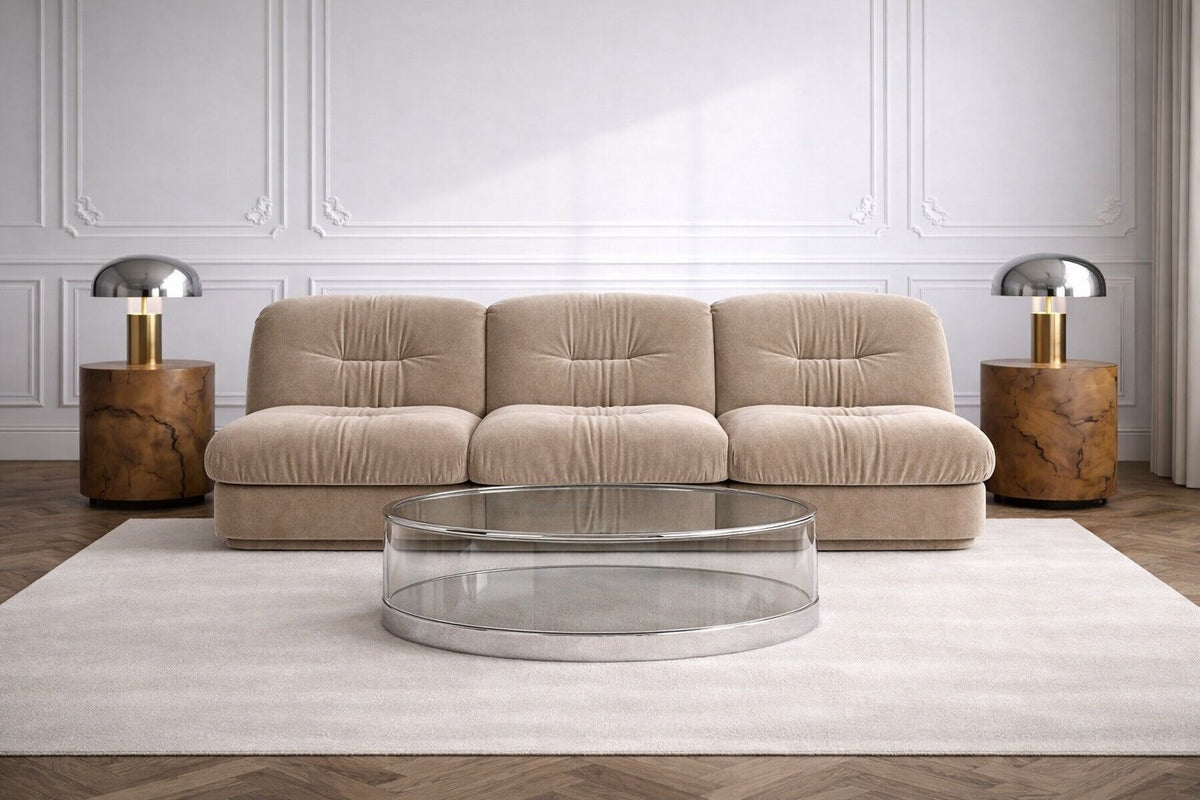
Disposable furniture is bought to be replaced. Collectible furniture is bought to be kept. The difference is not the number on the tag; it is a set of decisions taken before the piece exists: the frame, the fill, the fabric, whether the object can ever be opened again, and whether anyone can say where it was drawn and who made it.
How Disposable Furniture Is Built to Fail.
Disposable furniture is engineered around a hidden expiry date. Every decision is made to bring the object back to the shop floor sooner rather than later.
- The frame is stapled rather than jointed.
- The cushioning collapses within a season.
- The fabric pills the first time a glass is spilled.
- The whole object is priced to be thrown away and bought again.
Collectible furniture inverts every one of those decisions.
Where Collectibility Begins.
At Saint Objets a piece begins as a drawing made in Paris and is built to order in the Emirates. The proportions, the frame and the fabric are chosen for one specific room rather than for a warehouse pallet.
Nothing is produced to sit in stock waiting to be discounted. That single shift, from anonymous inventory to a named commission, is where collectibility actually starts.

Built to Be Opened Again.
The second half of the story is what happens over the years that follow. A collectible object is constructed to be opened again, not sealed shut, so it can be:
- recovered when a surface wears,
- reupholstered in a new fabric,
- passed on to another room or another generation.
Until that day, the fabric has to hold. Ours is developed for hospitality use, so the surface a family sits on every day does not give way to sunlight, cleaning or use, and it is toxic-free, because in a sealed, cooled room whatever is in the fabric is also in the air.
Why Provenance Holds Value.
Provenance matters too. Knowing where a piece was designed, how it was made and by whom is exactly what lets it hold meaning and value across a move, a redecoration, even a generation.
You can see how this thinking runs through our approach to French furniture in Dubai, where the ambition is always a piece kept on purpose rather than replaced by default.
Frequently asked questions.
Is collectible furniture just a way of saying expensive?
No. Price alone does not make a piece collectible. What matters is intention, provenance and whether it can be repaired and passed on. A made-to-order Saint Objets piece, designed in Paris and built in the Emirates, is collectible because it is meant to be kept, not because of a number on a tag.
Does made to order really make furniture last longer?
It changes how the piece is built. Because each Saint Objets commission is made for a specific room rather than mass-produced for stock, the frame, cushioning and fabric are chosen for real use. That care, combined with toxic-free materials and hospitality-grade fabrics, is what lets a piece survive daily life instead of wearing out.
Can a collectible piece be reupholstered later?
Yes, and that is part of the point. Collectible furniture is constructed to be opened, recovered and reupholstered, so it can move with you, change fabric, and outlive one interior. Disposable furniture is sealed and priced to be discarded. Saint Objets builds for the second life, not only the first.