
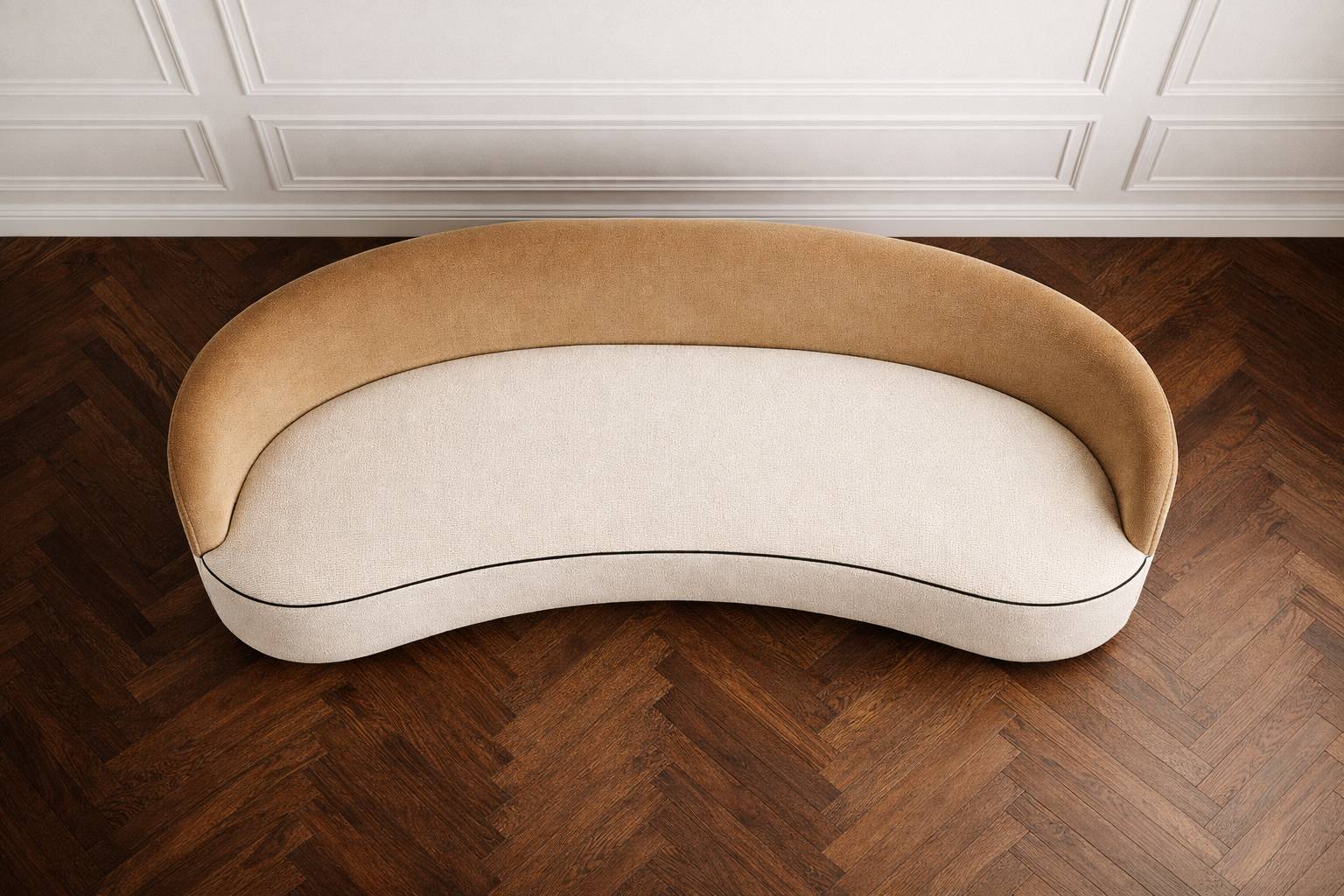
Two words travel together in this trade and are used as if they named one thing.
They do not. We keep them apart, and we say which one we are making.
Eco-Friendly and Toxic-Free Are Not the Same.
Eco-friendly is a claim about footprint: materials sourced, energy used, distance travelled, waste avoided. Toxic-free is narrower and more testable. It describes what a finished piece gives off into the room it stands in.
The two overlap. They remain two claims, and each one is answered with its own evidence.
What Toxic-Free Means Indoors.
A sofa shares your air for years. Toxic-free means the fabric and the materials beneath it are chosen with that in mind: healthy fabrics, low chemical emissions, nothing a room has to recover from.
Sarah Koben, Creative Director, brought this into the studio at the beginning. All our upholstery fabrics are certified to OEKO-TEX® STANDARD 100 and tested for harmful substances. The document belongs to the fabric, not to the house.

The Short Path.
No stock is held. Nothing is built before it is wanted. There is no importer, no distributor, no warehouse, no ocean crossing before a client has asked. A piece begins on the bench when it is ordered and goes from that bench to the home. Nothing is lost along the way, so nothing has to be taken out of the piece to make up for it.
The lead time is ten to thirty days, according to the scale of the project, the number of pieces and the availability of the chosen fabric.
Durability Is the Real Sustainability.
The lowest impact belongs to the piece that is kept. A frame that holds. A fabric that takes daily use. An upholstery that can be renewed rather than surrendered.
We build for the long stay. High-performance and hospitality-grade fabrics follow the same logic: a fabric that survives use is a fabric that stays in the room. A two year structural warranty covers the frame.
How to Judge a Green Claim.
Ask for the claim and for the evidence that sits behind it.
- Ask which fabric, and what is documented for that fabric.
- Ask where the piece is made, and how far it travels to reach you.
- Ask what happens when the upholstery wears.
Come and sit on the pieces at Decoroom, Art of Living Mall, Dubai. Feel the fabric. Everything else follows from that.
Frequently asked questions.
Is toxic-free the same as eco-friendly furniture?
No. Eco-friendly describes the footprint of a piece across sourcing, production, distance travelled and waste. Toxic-free describes what the finished piece releases into your indoor air. They are two claims and each one is answered on its own terms.
How can I tell if a toxic-free claim is real or greenwashing?
Ask what is documented for your fabric. A studio can name healthy fabrics, low chemical emissions and OEKO-TEX certified textiles. The document belongs to the fabric, so it is the fabric you ask about.
What actually makes Saint Objets furniture kinder to the planet?
The short path. No stock is held, so a piece is made only once it is ordered. It is built in our own atelier in the Emirates and goes from there to the home, with no importer, no distributor and no warehouse in between. And it is built to stay: high-performance and hospitality-grade fabrics, a frame carrying a two year structural warranty, upholstery that can be renewed. Sarah Koben, Creative Director, set that standard at the start.
Why does Saint Objets say durability is the real sustainability?
A piece that is kept replaces nothing. Making only to order means nothing is built that no one wanted, and high-performance fabrics let a piece take years of daily use. Furniture lead time is ten to thirty days, according to the scale of the project, the number of pieces and the availability of the chosen fabric.