
Present a tight edit of two or three resolved directions, not a catalogue. Reveal them in a fixed sequence: physical sample tray first, then a scaled plan or CAD showing the piece in the room, then a single costed comparison sheet. Make the comfort, durability, and silhouette trade-offs explicit, and secure the sign-off and payment at the moment of selection while the decision is live.
Why a Tight Edit Wins.
The mistake most designers make is showing too much. A client shown fifteen options does not feel served, they feel abandoned. The work a client is paying for is the filtering, so the deliverable is a curated shortlist, usually two or three fully resolved directions, each already tested against the brief, the light in the room, and how the household actually lives.
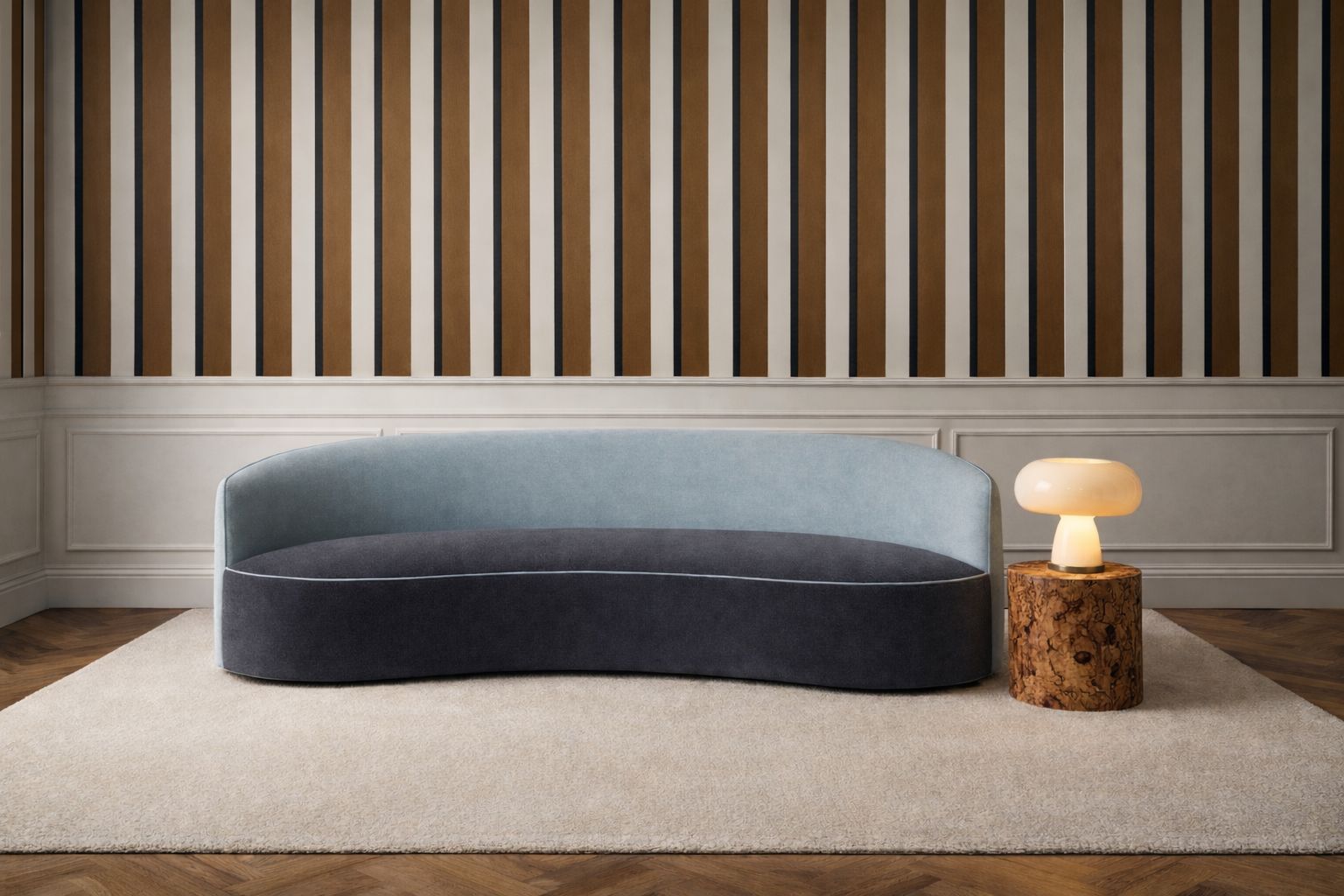
Take a family living-room sofa, the piece that has to survive real life and still hold the room. Instead of a sample book, the client sees two considered directions: a tight flat-weave that reads architectural and disciplined, set against a brushed mohair that reads soft and quiet. Same footprint, same budget band, two different rooms to live in. The point of narrowing to two is that the client can actually feel the fork, rather than drown in twelve near-identical neutrals.

The Order of the Reveal.
The mechanics matter as much as the edit, so give the presentation a fixed sequence:
- The physical sample tray. Lay the real materials in the client's hand, in the room's own daylight, because a screen cannot carry weave, nap, or sheen, and Dubai light flattens or lifts a tone in ways no render predicts.
- The scaled companion: a plan, a CAD elevation, and where the project warrants it, the footprint taped on the floor so the client stands inside the true dimension before anything is committed.
- A single costed comparison sheet that puts the two directions side by side so the difference is legible on one page, revealed last on purpose.
The scaled step is where the trade-off conversation happens out loud, with the sample still in hand:
- A deeper seat versus supportive posture.
- A high-performance fabric that survives a family and pets versus a more delicate hand that photographs richer.
- A crisp tailored back versus a lounge-soft one.
Reveal cost last, on purpose. The client should fall for the material and understand the trade-offs before a number frames the conversation. Presented in-studio by appointment, or in the room itself when the project is on site, the order is deliberate: feel it, place it, then price it.
When a Client Cannot Choose.
The hard part is not the tidy client who picks direction one. It is the client who wants to see more, or cannot choose. Resist reopening the catalogue. More options rarely resolve indecision, they dilute it, and a fourth and fifth direction usually signal that the brief itself is unsettled rather than the samples.
When a client stalls, narrow rather than widen: name the single variable actually in tension, most often durability against hand-feel, and put that one question to them directly. If they genuinely want to explore further, frame it as a paid sampling round on the two live directions, not an open re-brief, so the process keeps its spine.
Turning Selection Into Commission.
Then convert. Selection and commitment belong in the same moment, because a decision left to cool overnight loses its heat. Because each piece is made to order, the client is commissioning, not buying off a shelf, and the commission opens the instant they sign off the direction and confirm payment. Do this at the table, while the chosen sample is still in their hand, not in a follow-up email three days later.
The payment is not pressure, it is the honest mechanism that turns a preference into a place in the production queue, and clients understand that when it is framed as protecting their choice rather than closing a sale. This is also when lead time becomes real, so frame it as a range tied to their fabric and finish, never a false exact date, and be candid that a hospitality-grade performance fabric or a hand-selected finish can shift the window. Stock and availability are confirmed by the studio at order.
Clients relax when the mechanics are transparent, and they commit when the moment of choice and the moment of commitment are one and the same. If you want to see how the commission itself is structured, our bespoke furniture in Dubai page walks through it in full.
Frequently asked questions.
How many bespoke options should a designer show a client at once?
Show two or three fully resolved directions, not a full catalogue. A tight edit signals that you have done the filtering the client is paying you for. Fifteen options create decision paralysis, whereas a curated shortlist, each justified against the brief, moves the project forward and builds trust in your judgment. For a family living-room sofa, that can be as simple as one architectural flat-weave set against one soft brushed direction in the same footprint and budget band.
In what order should you present the samples, the plan, and the price?
Reveal them in a fixed sequence: physical sample tray first, then the scaled plan or CAD showing the piece in the room, then a single costed comparison sheet last. The client should feel the material and understand the trade-offs before a number frames the conversation. Feel it, place it, then price it. Present in-studio by appointment, or in the room itself when the project is on site.
What do you do when a client cannot decide between two directions?
Do not reopen the catalogue, since more options dilute a decision rather than resolve it. Narrow instead: name the single variable actually in tension, usually durability against hand-feel, and put that one question to the client directly. If they want to explore further, frame it as a paid sampling round on the two live directions, not an open re-brief.
When does the client actually commit to a bespoke commission?
At the moment of selection, while the chosen sample is still in their hand, not in a follow-up email days later. Because the piece is made to order, the commission opens when the client signs off the direction and confirms payment. Framed as protecting their choice and securing a place in the production queue rather than closing a sale, the payment is the honest mechanism that turns a preference into a commitment. This is also when lead time becomes real, expressed as a range tied to their fabric and finish, never a fixed exact date.