
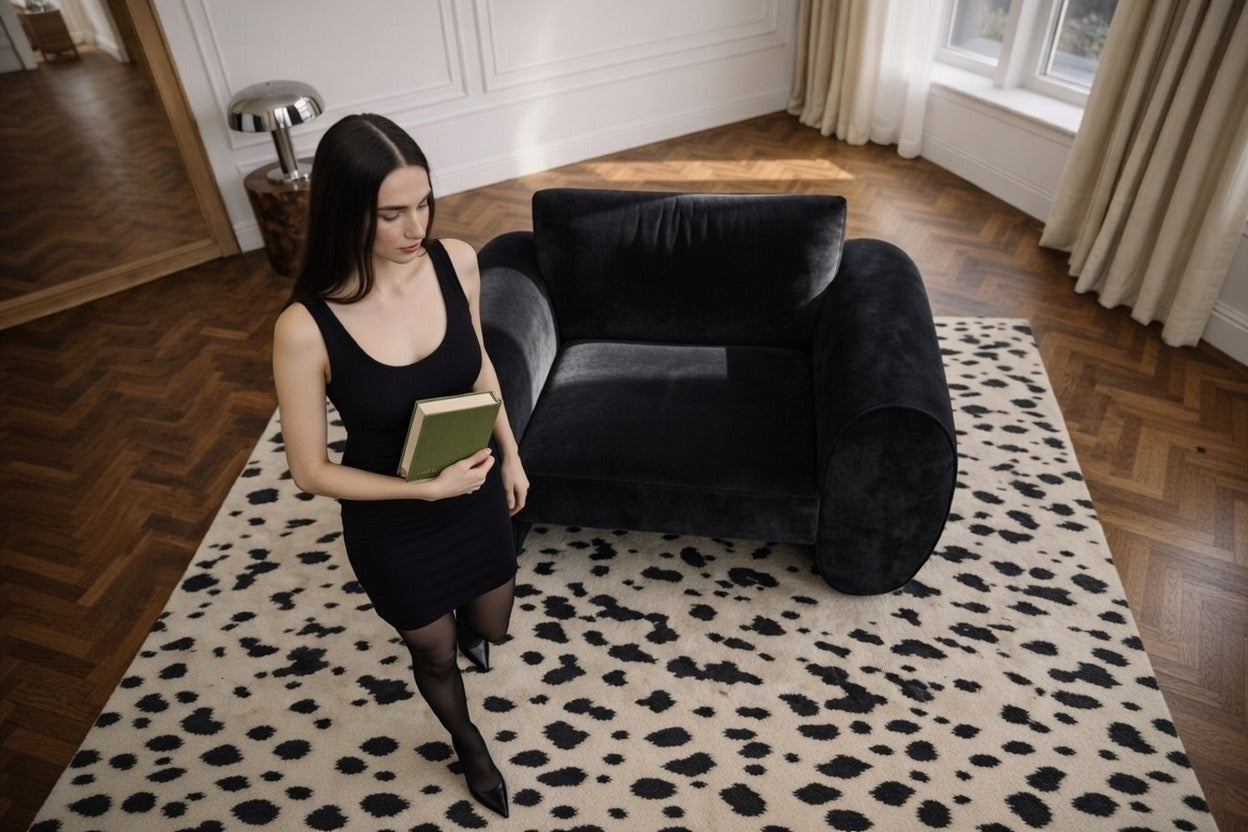
The upholstered core of a room is made by the studio itself, end to end, to the drawing and to the dimension: sofas, armchairs and occasional chairs, headboards, banquettes, ottomans and soft furnishings such as cushions and upholstered bases. The rug is not. It is woven to the studio's specification by a dedicated weaving trade, then colour-matched, sampled and signed off under the same palette and the same approval as the furniture. One specification, one sign-off, two kinds of making: scope the rug as coordinated production, not as in-house manufacture.
Why One Spec Holds a Scheme Together.
The real gain of one studio is not convenience, it is control of the variables that break a scheme on install day. When the sofa, occasional chairs, headboard and rug are specified together, the studio matches undertone to undertone, weave scale to weave scale, and sheen to sheen against the actual light of your room rather than a showroom's.
You approve physical samples cut from the exact fabrics, yarns and finishes going into production, so the greige on the sofa does not fight the greige on the rug and the timber on the console sits in the same warmth family as the bed. That coherence is difficult to retrofit once pieces are ordered from four houses on four timelines.
What Saint Objets Makes, and What It Coordinates.
Be precise about scope before you commit a room, because "one maker" is a claim worth interrogating. Saint Objets manufactures the upholstered and framed pieces itself, working to your drawings and building to bespoke dimension and configuration:
- Sofas and sofa beds
- Armchairs, dining and occasional chairs
- Headboards and upholstered bed bases
- Banquettes, benches and ottomans
- Soft furnishings such as cushions and upholstered bases
What it coordinates rather than makes in-house are the specialist trades a serious scheme still needs done by specialists, managed to a single specification and a single sign-off:
- Rugs, woven to the studio's spec and colourway by a dedicated weaving workshop
- Natural stone and marble
- Fine joinery or cabinetry, where a named joiner serves the piece better
You brief once, but you are not being told a weaver's loom sits in Dubai when it does not. That candour is the point of a single point of contact.

How a Full Commission Runs.
Because everything is made to order, the operational questions a designer needs answered run against your final spec, not off a shelf. Here is how a full commission behaves:
- Lead times run in bands: upholstered pieces at ten to thirty days once the specification is locked, framed and structural pieces at the longer end of that range, and a bespoke rug woven to colour at three to five weeks, made by hand in India, which is why it sets the critical path and is specified and sampled first.
- Deliveries are sequenced deliberately: the studio holds finished pieces and lands them together, or lands the rug and floor-level pieces ahead of upholstery so nothing is carried over a laid rug, rather than shipping each item the day it leaves production.
- Payment follows bespoke terms: a commission is confirmed on full payment at order, which reserves your production slot in the calendar.
- Sampling is a physical round: yarn poms and woven rug samples in your chosen colourway, cut fabric swatches, timber and finish samples, viewed together in the room's own light, iterated until the palette resolves, then locked in writing before anything is cut.
Build that sampling loop into your programme rather than treating it as a formality.
Reading the Performance Claims.
Two claims designers rightly refuse to take as adjectives are toxic-free and high-performance. Toxic-free means the studio builds with safe, non-toxic materials and can supply the composition and treatment documentation for the specific fabric or finish you choose.
High-performance and hospitality-grade are not moods, they are figures you should ask to see on the specific fabric. Name the exact fabric and ask, at specification stage, for:
- Its martindale abrasion count, in the tens of thousands of rubs for contract upholstery
- Its fire performance to the relevant standard for the setting
- Its compliance documentation on restricted substances
Hold the rug to its own traffic-rated construction, pile and backing for the room's actual underfloor conditions.
A Worked Example, and How to Brief.
On a recent residential scheme the brief called for a warm greige palette across a large sofa, a pair of occasional chairs and a floor rug. The upholstery fabric read as a clean stone grey indoors, but the first rug sample, specified separately to a "matching" grey, carried a faint green undertone that only surfaced under the room's warm evening light and made the sofa look cold beside it.
Because the rug and the fabric were being sampled together, in the actual room, that clash was caught at the sample stage: the rug yarn was re-dyed a half-step warmer toward the fabric's pink-grey base, re-sampled, and approved before a single metre was woven. Ordered from two houses on two timelines, that undertone conflict shows up on install day, when it is a return, a re-weave and a slipped handover. Held to one spec, it was a second yarn pom.
Brief the studio the way you would brief a joinery workshop: one moodboard, the room's real light, the pieces you want owned end to end, and the categories you would rather keep with a named specialist. Start with a by-appointment studio visit to handle the materials in person, then read how the commission runs on the French furniture studio in Dubai page before you hand over a full room.
Frequently asked questions.
Does Saint Objets actually make the rug, or source it?
The rug is made to Saint Objets' specification and colourway by a dedicated weaving trade, not woven on the studio floor. The studio owns the design, the colour-matching and the sign-off, and holds the rug to the same palette and approval as the furniture, but it is coordinated production rather than in-house manufacture. The furniture, by contrast, the sofas, chairs, headboards and soft furnishings, is made by the studio itself.
What does Saint Objets manufacture in-house, and what does it coordinate?
In-house: the upholstered and framed pieces, meaning sofas, sofa beds, armchairs, dining and occasional chairs, headboards, upholstered bed bases, banquettes, ottomans and soft furnishings, built to your drawings and to bespoke dimensions. Coordinated to a single spec and sign-off: rugs, natural stone and marble, and fine joinery where a named specialist serves the scheme better. You brief once, but you know exactly which categories go to a specialist trade.
How do lead times, payment and sampling work on a full commission?
Because everything is made to order, timings run in bands against your locked specification: upholstered and framed pieces at ten to thirty days, according to the scale of the project, the number of pieces and the availability of the chosen fabric, and a bespoke woven rug at three to five weeks, made by hand in India, which is why it is sampled first and sets the critical path. A commission is confirmed on full payment at order, which reserves your production slot. Sampling is physical, meaning yarn poms, rug samples, cut swatches and finish samples viewed together in your room's light, iterated, then locked in writing before anything is cut.
What standards back the toxic-free and hospitality-grade claims?
Toxic-free means safe, non-toxic materials, with the composition and treatment documented for the specific fabric you choose. Hospitality-grade is verifiable, not decorative: name the exact fabric and ask for its martindale abrasion count (tens of thousands of rubs for contract use), its fire performance rating for the setting (including the marine standard for a yacht), and its restricted-substances compliance sheet. Rugs are held to their own traffic-rated construction, pile and backing for the room's underfloor conditions.